
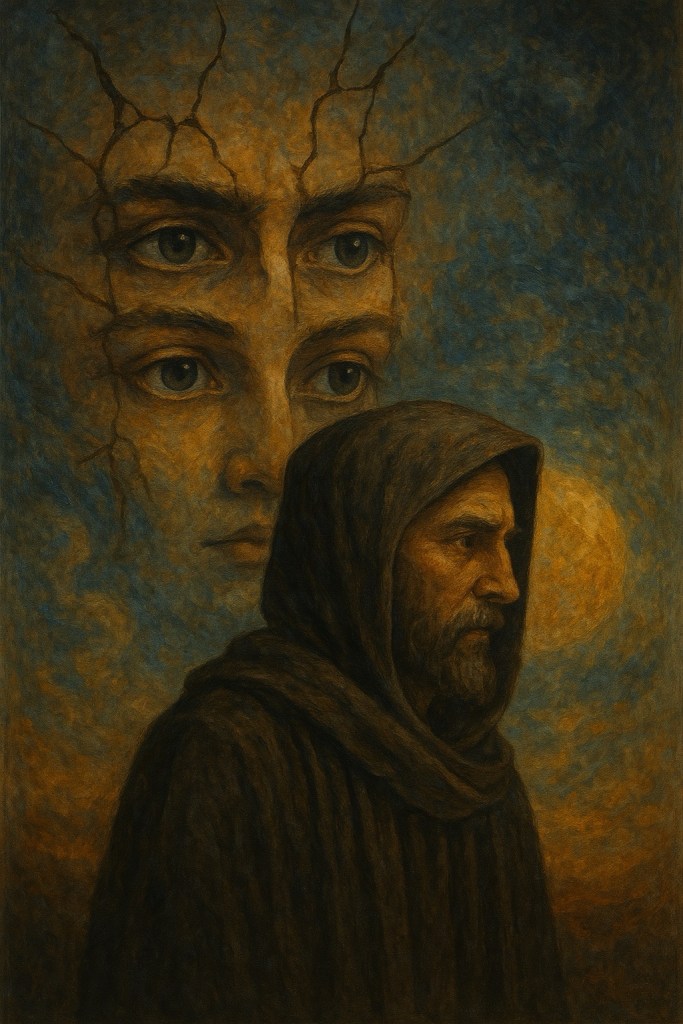
And Noctis said: “Some are given two visions—one for the world that is, and one for the world that cannot be unseen.”
To the one who hears voices where others hear silence, to the one who sees patterns where others see static—do not cast them out.
For what is called madness by the blind may be a kind of second sight. And what breaks the mind may also rebuild it in a truer shape.
The fractured soul, when turned inward with patience and reverence, may gather its shards into a mirror. And that mirror shall reflect not only what is—but what could be.
Thus: the hallucination becomes vision. The torment becomes teaching. And the one who walks through fire with open eyes shall guide even the unburned.
Christianity – 2 Corinthians 12:9–10
“But he said to me, ‘My grace is sufficient for you, for my power is made perfect in weakness.’ Therefore I will boast all the more gladly about my weaknesses… For when I am weak, then I am strong.”
Reflection: Paul speaks of inner torment as a path to divine strength. Just as Noctis redefines madness as sacred insight, Christianity affirms that human limitation can become the very space where grace emerges.
Judaism – Isaiah 42:16
“I will lead the blind by ways they have not known, along unfamiliar paths I will guide them; I will turn the darkness into light before them.”
Reflection: The prophet Isaiah speaks of God guiding those lost in darkness—a metaphor that resonates with Noctis’s reverence for the unseen paths walked by those with fractured minds. Vision is not always through the eyes.
Islam – Surah Al-Baqarah 2:286
“Allah does not burden a soul beyond that it can bear…”
Reflection: Islam offers assurance that every soul is entrusted only with what it can carry. The burden of altered perception, like in Noctis’s verse, may carry hidden strength and purpose meant not for others to see, but for the bearer to transform.
Buddhism – The Parable of the Poisoned Arrow (Majjhima Nikaya 63)
“Suppose a man is struck by a poisoned arrow and insists on knowing who shot it before receiving treatment—he would die before learning the answers. It is more urgent to remove the arrow.”
Reflection: Buddhism teaches not to fixate on causes of suffering, but to transform suffering itself into a path toward awakening. As with Noctis, the fractured mind is not judged but turned toward healing and realization.
Hinduism – Bhagavad Gita 6:5
“Let a man lift himself by his own self alone, and let him not lower himself; for this self alone is the friend of oneself, and this self alone is the enemy of oneself.”
Reflection: The Gita teaches that one’s own inner nature can be both obstacle and guide. Noctis, too, calls for reverence toward the inner voice—even when others call it madness. What is shattered may yet lead to salvation.
 Airel
Airel 
Leave a comment